

GIANO-B radial velocities improve the methods to use Cepheids as cosmological distance ladders
An international collaboration among researchers from France, Chile, Germany, Poland, and Italy has compared the cross-correlated radial velocity (RV) curves of five Cepheids, obtained simultaneously in the V band (with HARPS-N) and the H band (with GIANO-B). They found that, for all stars, the V-band RV curve amplitude is approximately 5% larger than that of the H band. This amplitude difference can be explained to first order by the wavelength dependence of the geometric projection factor (i.e., the ratio between the true pulsation velocity and the observed radial velocity), which is directly linked to the expected limb darkening in the V and H bands.
This study demonstrates that the amplitude difference between the V and H bands does not limit the parallax-of-pulsation method. Instead, it implies that an RV measurement obtained in a specific band must be paired with its corresponding projection factor. Furthermore, this work shows that for Cepheids, and pulsating stars in general, it is possible to infer the differential stellar limb darkening across two bands by comparing the observed amplitudes of their respective RV curves. Similarly, the distinct γ-velocity offsets observed in the V and H bands are typically addressed in the parallax-of-pulsation method by normalizing the average of the RV curve to zero.
Cepheid distances are computed by combining angular diameter measurements (obtained directly via interferometry or indirectly through the surface-brightness color relation) across the entire pulsation period with stellar radius variations derived from integrating the pulsation velocity. Accurately determining the projection factor has long been a major obstacle to using Cepheids as cosmological distance ladders; this study significantly helps overcome this challenge.
The observations leading to these results have been obtained thanks to the European Commission’s Seventh Framework Programme (FP7/2013-2016) under grant agreement number 312430 (OPTICON).
The full paper is available at http://arxiv.org/abs/2609.21855
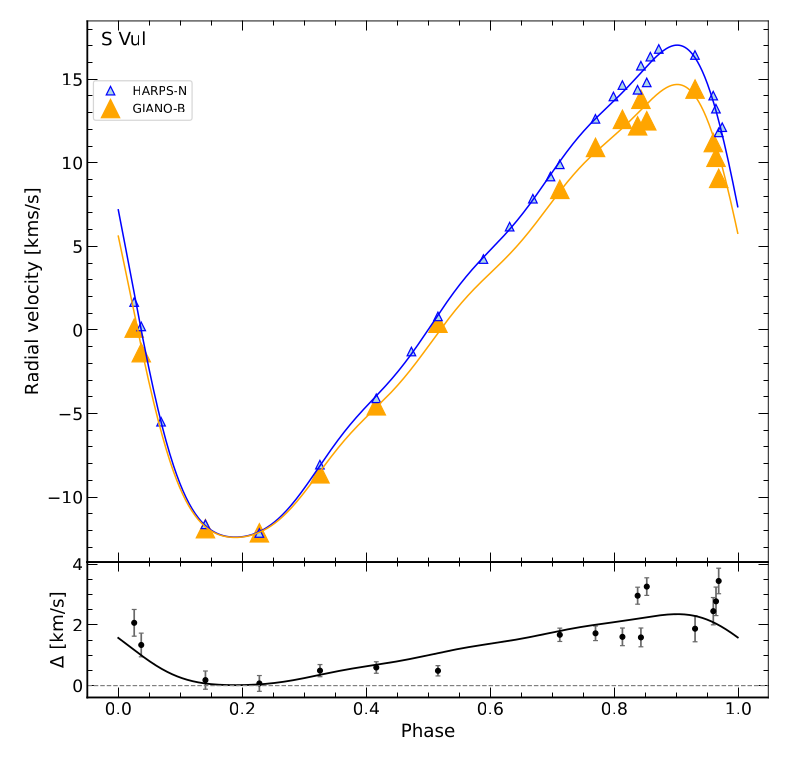
Comparison between HARPS-N (blue triangles) and GIANO-B (orange traiangles) radial velocities curves of S Vul. The amplitude difference is clearly noticed around the maximum.