

How massive are newborn planets? A closer look at the young V1298 Tau multi-planet system
Long-term observations with the HARPS-N spectrograph at the Telescopio Nazionale Galileo are helping astronomers investigate a compact system of four young planets, but the strong activity of their host star makes their masses difficult to measure.
Physical and architectural properties of young planetary systems can look very different from those of the mature population. Studying them offers a rare opportunity to investigate how planets form and evolve before their architecture settles into its final configuration. One particularly interesting example is V1298 Tau, a star approximately 20 million years old that hosts four confirmed transiting planets.
An international team within the Global Architecture of Planetary Systems (GAPS) programme led byMario Damasso (INAF-OATo) has analysed more than 380 high-resolution spectra collected with HARPS-N at the TNG over four and a half years. The goal was to constrain the planets’ masses using the tiny changes in the star’s motion caused by their gravitational pull, but the team faced one a major obstacle: V1298 Tau is a highly active star. Magnetic processes on its surface produce variations in the measured stellar motion that can be much stronger than the planetary signals themselves. To disentangle these effects, the team tested different methods of extracting radial velocities and modeling stellar activity, while also accounting for the gravitational interactions between the planets.
The results highlight just how challenging this task can be. The inferred masses depend on the data-analysis method and on how stellar activity is modeled. In some models, the measurements suggest that the outermost planets b and e could be much more massive than estimates based on transit-timing variations alone. For the innermost planets c and d, the analysis mainly provides updated upper limits.
The results are intriguing, but not yet conclusive. A more comprehensive multi-technique modeling will be needed to establish the planets’ true masses, and the large HARPS-N dataset offers a unique opportunity for future innovative and independent analyses. Despite all the uncertainties, the study helps our understanding of how planetary systems emerge and evolve during their earliest stages.
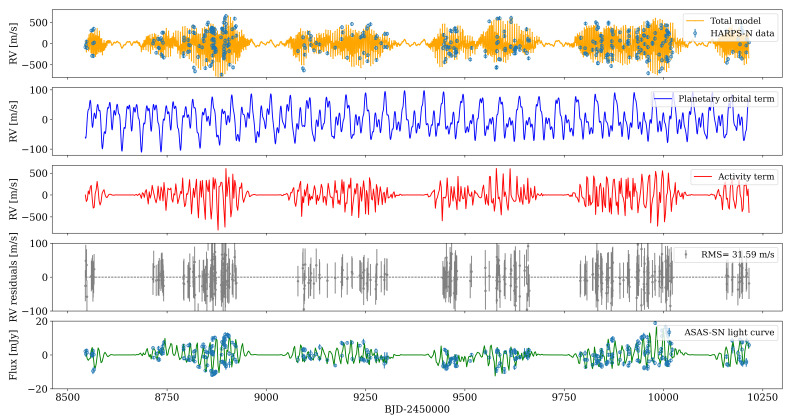
Results for the GP 2D regression using the ASAS-SN light curve as the activity diagnostic applied to snfit RVs. First panel. RV time series and total best-fit model planetary+activity signals (orange curve) Second panel. Best-fit model for the planetary orbital term only. Third panel. Best-fit model for the GP QP activity term only Fourth panel. RV residuals, after subtracting the total best-fit model from the snfit RV dataset. The error bars include a jitter term added in quadrature. Last panel. Best-fit model for the ASAS-SN light curve. For more details, see the paper.